


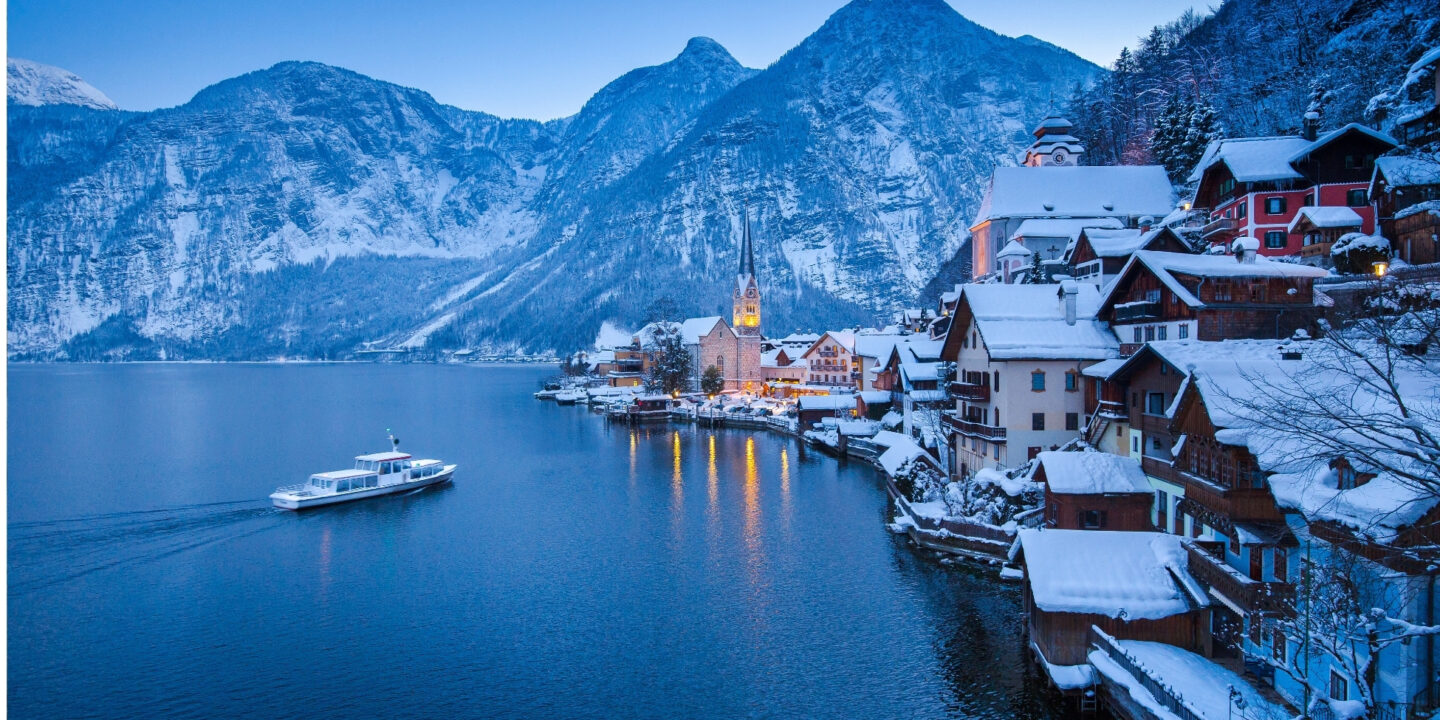
Invest and enjoy in Austria
-
Process
-
Austria
Austria, very centrally located in Europe, after its power the Habsburg Empire (the Austro-Hungarian Monarchy), has been somewhat self-centered for years. Meanwhile, and especially after EU accession, Austria is trying to maneuver itself more into an internationally connecting role. With the UN sub-office in Vienna starting in the 1960s and the UNO city completed around 1980, Vienna gained more influence in the world if only as host of important conferences. Outstanding hosts, by the way, the Austrians have been in their Gasthäuser since the Middle Ages.
Austrians like to build solid and durable
Focusing on yourself can also be easy when you have beautiful nature to enjoy yourself. Austrians are a proud people. Not so much of the conquests of yesteryear, or technologically advanced science and industry of today, no, they are proud of their landscape and their handling of that beautiful nature. For example, in late summer they search, find and pick plenty of mushrooms, including Eierschwammerl and Steinpilze, in the forested hills and mountains. They also call this Schwammerlklauben. Between 7 a.m. and 6 p.m., you may pick a maximum of 2 kg per day per person. If you pick more Chanterelles or Ceps you can be fined up to 3680 Euro. This mushroom picking typifies the Austrian mentality.

Being sporty and useful while enjoying the beauty and quality of the Heimat. You can also see this in residential construction. Austrians like to build solid and durable. Classic and modern intersect in building styles and interiors. When an Austrian builds a house, he also thinks in the back of his mind about his children who will inherit and take it over one day. That increases this qualitative thinking: you don’t want to leave a mess for your children. Even in second homes, you can see this quality thinking as the main guideline with the Austrian developer (Bauträger) and builder: we build solidly and yes it is logical that it costs a bit more. It is rather the foreign developers who seek compromises here. Whereas in the Benelux countries a house from the 60s and 70s is quickly demolished, in Austria you see more generalsanierung: Everything but the shell is stripped and a passive house with a stable base from the last century is created.
Belgians and Dutch often invest in Austria for the following reasons
First, they have become excited – ignited by Austrian pride in nature – by the country’s splendor and beauty (also literally, as you hardly see litter). The Ardennes and the Veluwe are beautiful, but in the Alps you will find the superlatives of natural beauty, and that in all seasons! Many therefore enjoy their 2nd home several times a year.
Secondly, amenities are at a high level. Whether it’s the smooth Autobahnen, the modern ski elevators, the perfectly groomed slopes or the other sporting and recreational offerings, the Austrians, and in particular Salzburg, Tyrol and Vorarlberg, continually invest in upgrading comforts and discovering new tourist opportunities.
Third, attractive returns can often be achieved through tourist rentals in both summer and winter. Of course, rising house prices depress returns, but compared to savings rates, you are still net about 3-4% above, generally speaking.
The fourth, a not unimportant point, is that the market is stable and the economy robust. Austria, as one of the few European countries, did not feel much of the 2008 crisis. From 2000 to 2008 prices rose slightly, since 2008 we have seen an annual increase especially in used real estate. For new construction in the ski resorts we see a very strong increase as land has become scarce and there is a shortage of building capacity. The expectation of many economists is that this will continue for quite some time, partly due to the low interest rates.
A second home in Austria
Many who buy a 2nd home finance about 50% of the total cost with debt capital. Usually the income from rentals can bear the interest and repayment of this loan. Austrian banks lend for 2nd homes at attractive terms. In Belgium, if you have surplus value on the first residence, you can (also) cash it in. For the Dutch this is often less easy and one has to rely on the Austrian (local) banks. In short, a 2nd home in Austria is in many ways a smart and fine investment!
Source: Alpreal – Karin Eegdeman
A list of articles
-

What about tax and VAT on rental income in Austria?
-
Austria
-
Financial
-
Process
-
Rental
-
-
Austrian housing market
-
Austria
-
General
-
-

Buying a holiday home with Zweitwohnsitz in Austria
-
Austria
-
Process
-